Best Protein Powder for Women: How to Choose, Plus 5 Compared
How much protein women need, what actually matters on the label, and five plant-based protein powders compared side by side.

Walk down the supplement aisle and you'll find protein powders made "for women," often in smaller tubs with softer colors. But protein doesn't work differently for women. What matters is how much protein you need, what else is in the scoop, and how it's been tested.
Here's how to choose, plus five plant-based protein powders compared side by side. One of them is ours, fitppl Optimal Plant Protein, so keep that in mind as you read. Every number below comes from a label or an independent lab, with sources at the end, and we've noted where others come out ahead.
The short answer
- You don't need a "women's" formula. How much protein you need depends on your body weight, how active you are and whether you're pregnant, not on what the label says.
- Simplest label: fitppl Optimal, with 26g of protein from four organic ingredients and 8.4mg of iron.1
- Most protein per serving: Garden of Life Sport, with 30g and NSF Certified for Sport, but it had the most lead of the five in Consumer Reports' testing.23
- Lowest lead in independent testing: Truvani and Ritual, both just over half a microgram per serving.4
- Lowest price: Orgain, at about $1.90 a serving.5
How much protein do women need?
The recommended amount for adults is 0.8g of protein per kilogram of body weight a day. That works out to about 46g a day for an average adult woman, and 71g a day during pregnancy.6 If you strength train or are very active, the International Society of Sports Nutrition suggests 1.4 to 2.0g per kilogram a day.7
For a 140-pound (64kg) woman, that's about 51g a day as a baseline, or roughly 89 to 127g if she trains hard. Most women can get there from food. A protein powder is an easy way to add 20 to 30g when meals fall short.
What to look for in a protein powder
| What to check | Why it matters |
|---|---|
| Protein per serving | 20 to 30g is typical. Check whether a serving is one scoop or two. |
| Iron | Women 19 to 50 need 18mg of iron a day, more than twice the 8mg men need, and 27mg during pregnancy.8 Some plant protein powders provide a good share of that. |
| Sweetener | Most powders use stevia, sugar alcohols like erythritol, sucralose or monk fruit. Pick one you're comfortable with. |
| Ingredient list | Gums, creamers and "natural flavors" improve texture and taste but make the list longer. |
| Heavy metal testing | Plant proteins tend to have more lead than dairy.9 The FDA's reference level for lead from all food is 8.8 mcg a day for women of childbearing age.10 Look for brands that publish results. |
| Certifications | USDA Organic covers how ingredients are grown. NSF Certified for Sport matters if you're an athlete who gets drug tested. |
A note on iron
Iron from plants is absorbed less easily than iron from meat, fish and poultry, which is why iron recommendations for vegetarians are 1.8 times higher than for people who eat meat.8 Of the powders below, Optimal lists 8.4mg of iron per serving, Garden of Life Sport lists 6.7mg and Ritual lists 3mg.11112 The amounts vary a lot, so check the Nutrition Facts panel. A protein powder isn't a replacement for an iron supplement your doctor recommends.
Five plant-based protein powders, compared
| Protein powder | Protein (serving) | Calories | Sugar | Sweetener | Gums | USDA Organic | Price / serving |
|---|---|---|---|---|---|---|---|
| fitppl Optimal | 26g (36g) | 150 | 0g | Monk fruit | None | Yes | $2.33 |
| Ritual Essential Protein 18+ | 20g (31g) | 120 | 0g | Stevia extract (Reb M), monk fruit | Xanthan | No | $3.33 |
| Truvani | 20g (29g) | 130 | 2g, 0g added | Monk fruit | None | Yes | $2.49 |
| Orgain Organic Protein | 21g (46g) | 150 | 0g | Erythritol, stevia | Acacia, guar, xanthan | Yes | $1.90 |
| Garden of Life Sport | 30g (45g) | 170 | Less than 1g | Stevia | Guar | Yes | $2.53 |
Figures are for vanilla, per serving, from each brand's label.113141511 Prices are one-time list prices for the standard size, checked in November 2026, and they change often.13165
fitppl Optimal Plant Protein
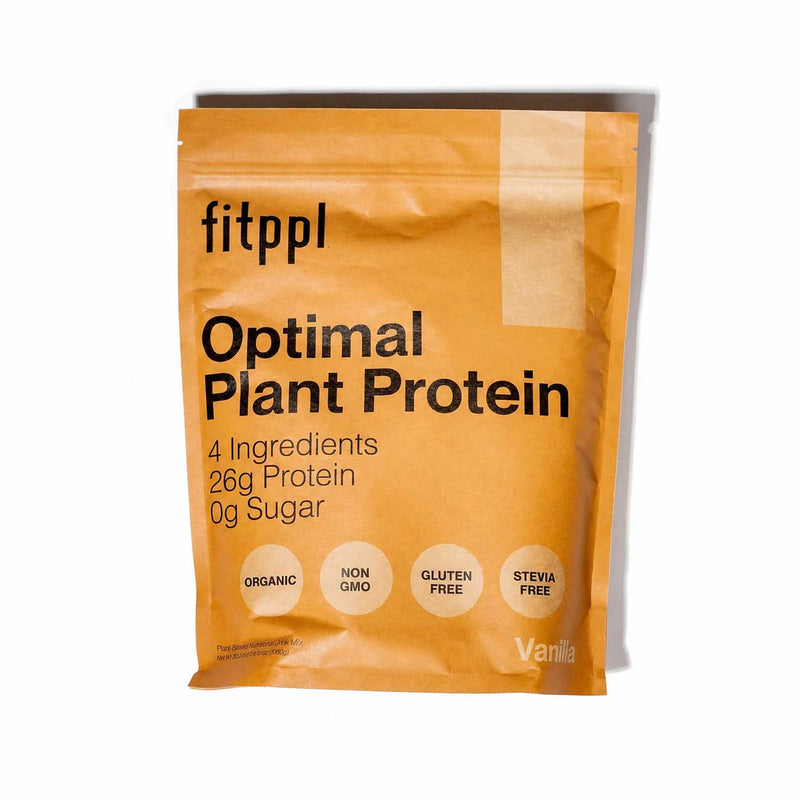
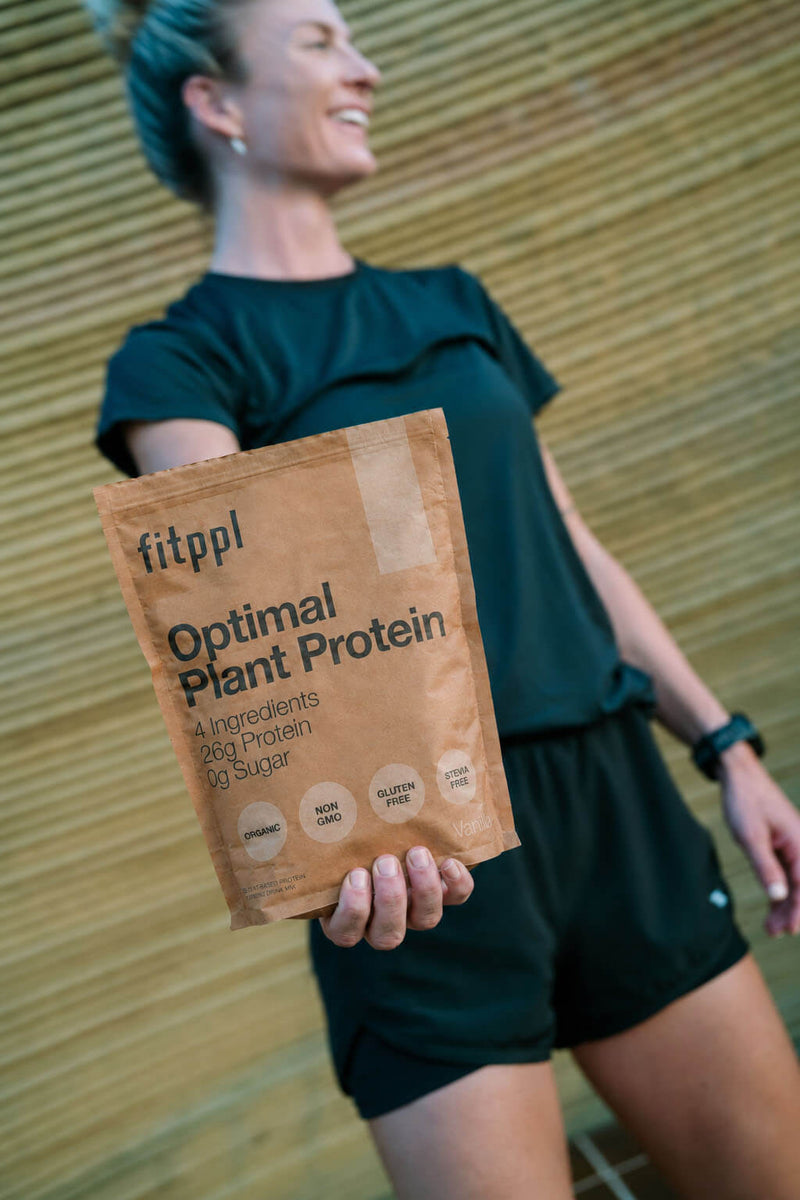
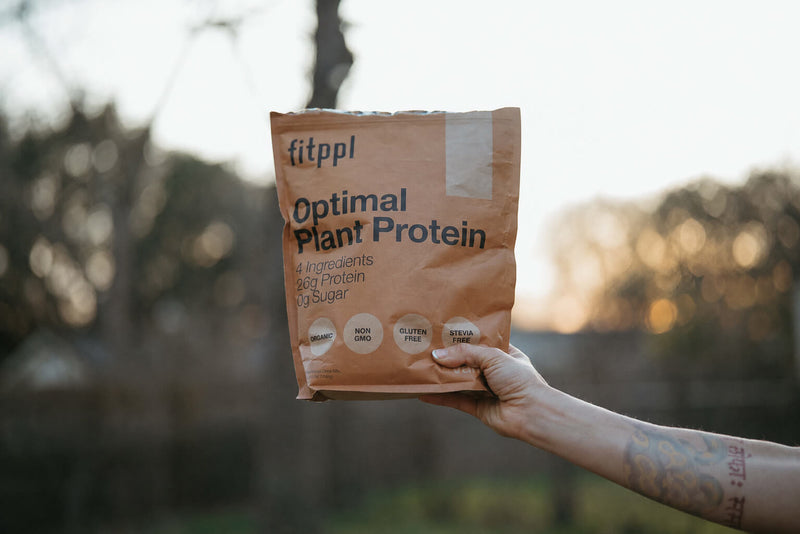
Optimal is made from four ingredients: organic pea protein, organic brown rice protein, organic vanilla and organic monk fruit. Each serving has 26g of protein, 150 calories, 0g of sugar and 8.4mg of iron.1 It's USDA Organic, Non-GMO Project Verified and certified gluten-free, and we publish its heavy metal results.
Good fit if: you want plenty of protein from the shortest ingredient list.
Trade-offs: it costs more per serving than Orgain, and its lead and cadmium results were higher than Truvani's and Ritual's.
Ritual Essential Protein Daily Shake 18+
Ritual's shake is the only one here marketed for a specific group, adults 18 and older. It has 20g of organic pea protein, 120 calories and 0g of sugar per serving, with added choline and L-methionine.13 It's sweetened with Reb M, an extract from the stevia leaf, plus monk fruit, and it uses xanthan gum and natural flavor. It isn't certified organic, though some ingredients are.13 Ritual says it tests every lot for heavy metals and shares the results.13
Good fit if: you want a lower-calorie shake from a brand that shares lot-by-lot test results.
Trade-offs: the highest price here, tied for the least protein, and stevia extract, gum and natural flavor.
Truvani Plant Based Protein
Truvani has five organic ingredients: pea protein, vanilla, pumpkin seed, monk fruit and chia seed protein. A serving has 20g of protein, 130 calories and 2g of sugar, none of it added.14 It had the lowest lead of the five in Consumer Reports' testing, with cadmium similar to ours.4
Good fit if: you want a simple, monk fruit-sweetened powder and don't need as much protein per scoop.
Trade-offs: 6g less protein per serving than Optimal.
Orgain Organic Protein
Orgain blends organic pea, brown rice and chia seed protein for 21g of protein per two-scoop serving, and it's the least expensive here.155 The trade-off is a longer list, with a creamer base, three gums and a sweetener blend of erythritol and stevia.15
Good fit if: price matters most and you're fine with erythritol and stevia.
Trade-offs: two scoops per serving and a long ingredient list. Read our full Orgain review.
Garden of Life Sport Organic Plant-Based Protein
Garden of Life Sport has the most protein here, 30g per two-scoop serving, plus 6.7mg of iron.11 It's NSF Certified for Sport, which tests for substances banned in sports.2 It's sweetened with stevia.
Good fit if: you want the most protein per serving or need NSF Certified for Sport.
Trade-offs: it had the highest lead of the five in Consumer Reports' testing.3 Read our full Garden of Life review.
Heavy metals: how the five compare
We compare results with USP <2232>. USP <2232> is the U.S. Pharmacopeia's standard for heavy metals in dietary supplements. It sets daily limits of 5 mcg of lead, 5 mcg of cadmium, 15 mcg of inorganic arsenic and 15 mcg of mercury. Following it is voluntary, but it's a common benchmark for testing supplements.17
| Per serving | Lead | Cadmium | Tested by |
|---|---|---|---|
| Truvani, chocolate | 0.46 mcg | 3.27 mcg | Consumer Reports, 20264 |
| Ritual Essential Protein, chocolate | 0.53 mcg | 1.94 mcg | Consumer Reports, 20264 |
| Orgain, vanilla bean | 0.70 mcg | 1.03 mcg | Consumer Reports, 20253 |
| fitppl Optimal, vanilla | 1.01 mcg | 3.35 mcg | Light Labs, Sept 20261 |
| Garden of Life Sport, vanilla | 2.76 mcg | 1.93 mcg | Consumer Reports, 20253 |
| USP <2232> daily limit | 5 mcg | 5 mcg | U.S. Pharmacopeia17 |
All five were under the USP limits for lead and cadmium. These results come from different labs, batches and years, so treat them as a snapshot. For the full picture, including arsenic and mercury, read our guide to lead in protein powder.
If you're pregnant or breastfeeding
Your protein needs go up during pregnancy, to about 71g a day.6 At the same time, Consumer Reports says pregnant people are among the most vulnerable to lead and should be especially cautious with protein supplements.9 Talk to your doctor or midwife before adding one, and if you do, choose a brand that publishes recent heavy metal results.
The bottom line
The best protein powder for women is the one that fits your protein needs, your taste and what you want to avoid. Skip the "for women" marketing and look at the label: protein per serving, iron, sweetener, ingredient list and published test results. If you want plenty of protein from a short ingredient list, Optimal is a good place to start. If lowest lead matters most, Truvani and Ritual tested lowest. Compare more options in our guide to the best plant-based protein powders.
Sources 17
Numbers in the article link to these sources.
- fitppl. Optimal Plant Protein Nutrition Facts and Light Labs heavy metal report (tested September 7, 2026).
- Garden of Life. Sport Organic Plant-Based Protein, Vanilla.
- Consumer Reports. Protein powders and shakes: methodology and test results. October 2025.
- Consumer Reports. Protein supplements: test methodology and test results. January 2026.
- Orgain. Organic Protein Plant Based Protein Powder, Vanilla Bean.
- Institute of Medicine. Dietary Reference Intakes for Energy, Carbohydrate, Fiber, Fat, Fatty Acids, Cholesterol, Protein, and Amino Acids. National Academies Press, 2005.
- Jäger R, et al. International Society of Sports Nutrition Position Stand: protein and exercise. Journal of the International Society of Sports Nutrition, 2017.
- International Food Information Council. What is iron? April 2022.
- Consumer Reports. Protein powders and shakes contain high levels of lead. October 2025, updated January 2026.
- Flannery BM, Middleton KB. Updated interim reference levels for dietary lead to support FDA's Closer to Zero action plan. Regulatory Toxicology and Pharmacology, 2022.
- Garden of Life Sport Organic Plant-Based Protein, Vanilla. Product label via Vitacost.
- Ritual Essential Protein Daily Shake, Vanilla. Product label via Vitacost.
- Ritual. Essential Protein Daily Shake 18+: Supplement Facts, ingredients, testing and price.
- Truvani Organic Plant Based Protein Powder, Vanilla. Product label via Whole Foods Market.
- Orgain Organic Protein Plant Based Powder, Vanilla Bean. Product label via Kroger.
- Truvani Plant Based Protein, Vanilla, 20 servings. Price via SuppCo.
- USP General Chapter <2232> Elemental Contaminants in Dietary Supplements: daily limits for lead, cadmium, arsenic and mercury, as summarized by BSCG.