How Much Protein Powder Per Day? Scoops by Weight and Goal
How much protein you need by body weight and activity, how to turn that into scoops, and when more than one or two scoops adds up in calories and heavy metals.

Most people who buy protein powder ask the same thing within a week: how many scoops should I actually be having? The honest answer is that it depends on how much protein you already get from food. For most people that works out to one or two scoops a day, and sometimes none.
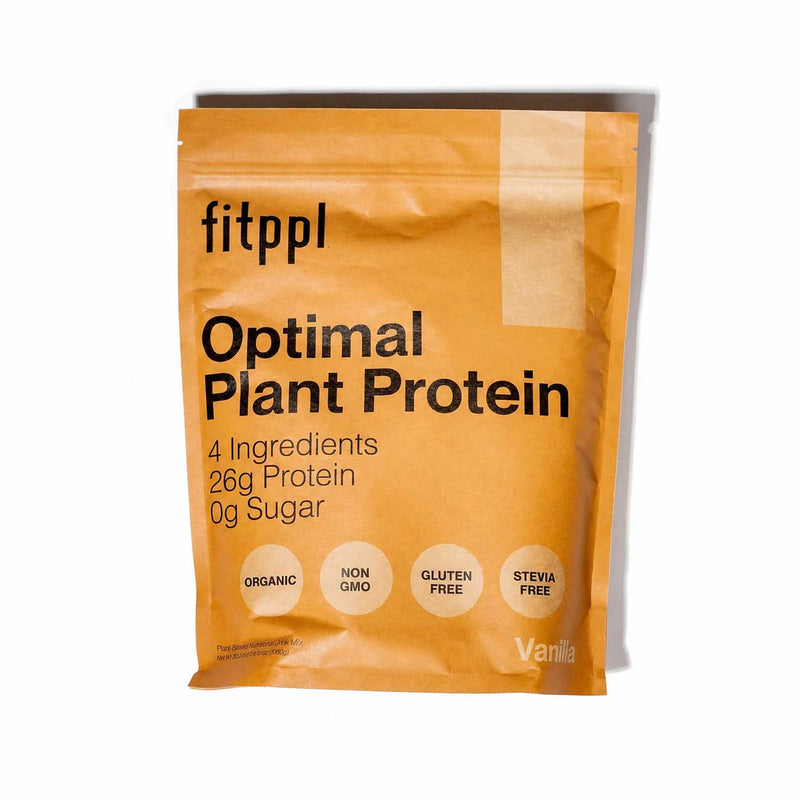
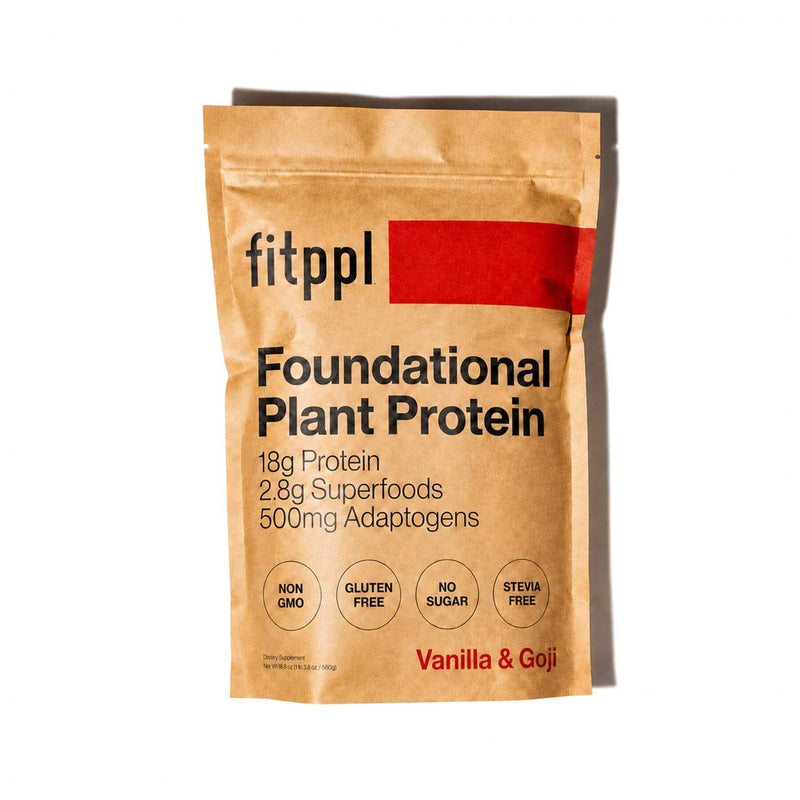
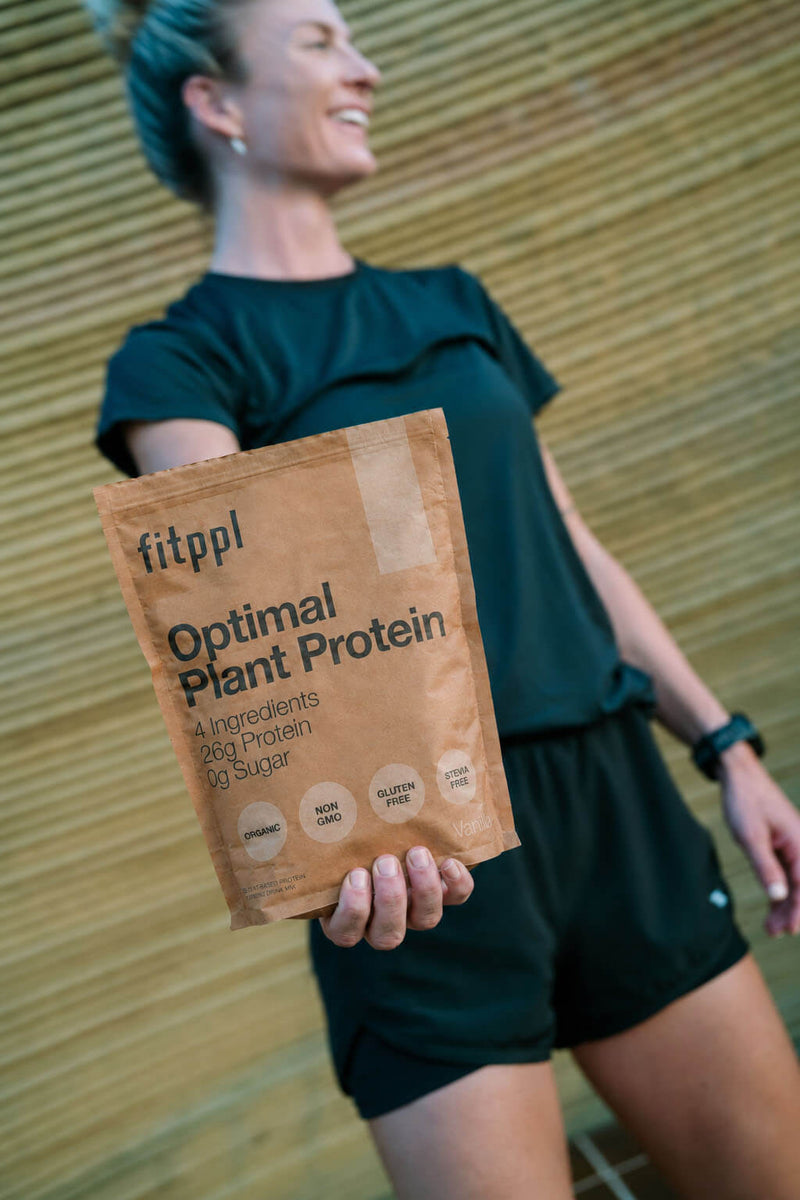
Below is how much protein you need by body weight and activity, how to turn that into scoops, and when more powder starts to add up in calories and heavy metals. We make two plant protein powders, Optimal and Foundational, so keep that in mind as you read. Every number comes from a study, a guideline or a label, with sources at the end.
The short answer
- Start with your daily protein target, not the scoop. The baseline for adults is 0.8g per kilogram of body weight a day.1 Active people are often advised 1.4 to 2.0g per kilogram.4
- Get most of it from food. Whole foods can cover protein needs for most people, including active ones.4 Powder fills the gap.
- One to two scoops a day covers most gaps. A scoop of our powders has 18 to 26g of protein, close to the 20 to 40g per serving the research on exercise uses.4
- More scoops add up. Calories add up, and so do heavy metals. Limits like USP <2232> are set per day, not per scoop.10
How much protein do you need a day?
There isn't one number. It depends on your body weight, how active you are and your age.
- Baseline: 0.8g per kilogram. This is the Recommended Dietary Allowance for adults from the Institute of Medicine. It's the amount that meets the needs of nearly all healthy adults, not a target for building muscle.1
- The 2025 to 2030 Dietary Guidelines: 1.2 to 1.6g per kilogram. The new Dietary Guidelines for Americans, released in January 2026, say to prioritize protein at every meal and aim for 1.2 to 1.6g per kilogram a day, from a variety of animal and plant foods.2 Not everyone agrees. Nutrition researchers at Harvard have questioned raising protein targets without saying more about which protein sources to choose.3
- Active people: 1.4 to 2.0g per kilogram. That's the range the International Society of Sports Nutrition recommends for most people who exercise.4
Here's what those ranges look like in grams:
| Body weight | Baseline (0.8g/kg) | Dietary Guidelines (1.2 to 1.6g/kg) | Active (1.4 to 2.0g/kg) |
|---|---|---|---|
| 120 lb (54kg) | 44g | 65 to 87g | 76 to 109g |
| 150 lb (68kg) | 54g | 82 to 109g | 95 to 136g |
| 180 lb (82kg) | 65g | 98 to 131g | 114 to 163g |
| 210 lb (95kg) | 76g | 114 to 152g | 133 to 191g |
To find your own number, divide your weight in pounds by 2.2 to get kilograms, then multiply by the rate that fits you.
If you're strength training
More isn't always better. A meta-analysis of 49 trials with 1,863 people found that protein supplements added to resistance training improved muscle mass and strength, but the extra benefit leveled off at about 1.6g per kilogram of total daily protein. The authors also noted that the training itself was a far more powerful driver of strength than the protein.5
If you're over 65
Older adults may need more than the baseline. An international expert group, PROT-AGE, recommends that adults over 65 average at least 1.0 to 1.2g per kilogram a day.7 If you have a health condition, ask your doctor what's right for you. For targets by body weight and how to spread protein across meals, see our guide to how much protein older adults need.
Food first, then fill the gap
Protein powder is a convenient way to add protein, not a replacement for meals. The ISSN notes that whole foods can meet the protein needs of most active people.4 Food also brings fiber, vitamins and minerals that a scoop of powder doesn't, and the Dietary Guidelines recommend getting protein from a mix of foods, such as eggs, poultry, seafood, beans, peas, lentils, nuts, seeds and soy.2
So the useful question isn't "how much protein powder should I take?" It's "how far short of my target does food leave me?" Powder covers that difference.
How many scoops of protein powder a day?
Here's the simple math:
- Find your daily target from the table above.
- Estimate what your meals already give you. A few days of checking labels or using a food tracking app is enough.
- Divide the gap by the protein in one scoop of your powder. That's your number of scoops.
For example, say you weigh 150 lb (68kg), strength train and aim for 1.4g per kilogram. That's about 95g a day. If your three meals give you about 25g each, you're at 75g and about 20g short. One scoop covers it.
If the gap is bigger, it's often easier to add protein to a meal than to add a third shake. And if food already gets you to your target, you don't need powder at all.
How much protein powder at once?
The ISSN suggests about 0.25g of protein per kilogram of body weight per serving, or 20 to 40g, spread out every three to four hours.4 A review on how much protein the body can use for muscle in one meal suggests about 0.4g per kilogram per meal across at least four meals.6 For a 150 lb person, that's roughly 17 to 27g at a time, about one scoop. If you're having two scoops a day, splitting them between two meals or snacks fits that research better than drinking both at once.
When more than one or two scoops starts to add up
Calories
A scoop of protein powder usually has 100 to 150 calories before you add anything to it. Three scoops of a 150-calorie powder is 450 calories, before milk, fruit or nut butter. If those shakes replace food, that's fine. If they're on top of everything you already eat, you're adding calories. If weight loss is your goal, see our guide to protein powder for weight loss.
Heavy metals
Plants absorb heavy metals from the soil they grow in, and in 2025 Consumer Reports found plant-based protein products had about nine times the lead of dairy-based ones on average.12 That matters more as the number of scoops goes up.
Many brands compare their results with USP <2232>. USP <2232> is the U.S. Pharmacopeia's standard for heavy metals in dietary supplements. It sets daily limits of 5 mcg of lead, 5 mcg of cadmium, 15 mcg of inorganic arsenic and 15 mcg of mercury. Following it is voluntary, but it's a common benchmark for testing supplements.10 The limits are per day, and results are checked against the most servings a day the label recommends.11 So a powder that's under the limits at one scoop can be over them at two or three.
Here's that math for our own Optimal Plant Protein, which tested at 1.01 mcg of lead and 3.35 mcg of cadmium per 36g serving in September 2026:13
| Optimal per day | Lead | Cadmium |
|---|---|---|
| 1 scoop | 1.01 mcg | 3.35 mcg |
| 2 scoops | 2.02 mcg | 6.70 mcg |
| 3 scoops | 3.03 mcg | 10.05 mcg |
| USP <2232> daily limit | 5 mcg | 5 mcg |
One scoop is under both limits. Two scoops is still under the lead limit but over the cadmium limit. If you want more protein than one scoop of Optimal gives you, food is the better place to get it. Whatever powder you use, multiply its per-serving results by the number of scoops you actually take. More in our guide to lead in protein powder.
Crowding out food
Every shake that replaces a meal also replaces whatever else that meal would have brought: fiber, vitamins, minerals and variety. One or two shakes a day leaves plenty of room for food. Most of your meals being shakes doesn't.
Is there a maximum amount of protein a day?
The Institute of Medicine didn't set an upper limit for protein. It suggests getting 10% to 35% of your calories from protein.1 A review of 28 studies found that higher-protein diets didn't harm kidney function in healthy adults.9
That doesn't apply to everyone. People with kidney disease may need to limit how much protein they eat,8 so if that's you, talk to your doctor or a dietitian before adding protein powder. The same goes if you're pregnant, breastfeeding or buying for a child. For more on safety, see is protein powder bad for you?
Our proteins, per scoop
| Optimal Plant Protein | Foundational Plant Protein | |
|---|---|---|
| Serving | 1 heaping scoop (36g) | 1 serving (28g) |
| Protein | 26g | 18g |
| Calories | 150 | 100 |
| Sweetened with | Organic monk fruit | Monk fruit |
| Also in it | Nothing else: pea and brown rice protein, vanilla, monk fruit | Organic fruit, greens and an adaptogen blend |
Figures are from each product's label.1314 Optimal covers a bigger gap in one scoop. Foundational is a smaller top-up at 100 calories.
Here's what two verified buyers wrote, word for word:
"I have been using this protein powder almost every day for the past few years. I love that it is made of natural plant proteins, it's organic, and has no GMOs. It also tastes great just by simply mixing with with water or blending bananas/strawberries into it. Recommended!"
Jon S., verified buyer, Optimal Plant Protein
"My husband and I use this every day! Great ingredients and even better flavor!"
Brooke B., verified buyer, Foundational Plant Protein
Ways to use your scoop
- Shake it with water or unsweetened plant milk for the lightest option.
- Blend it into a smoothie with fruit and greens. Our protein shake recipes have 16 ideas.
- Stir it into oatmeal or yogurt to add protein to a meal you're already eating.
- Don't stress about timing. Total protein across the day matters more than the exact moment. More in when to take protein powder.
Protein needs for women follow the same per-kilogram math. For what else to look for, see our guide to the best protein powder for women.
The bottom line
Work out your daily protein target, see how much food already gives you, and use protein powder to cover the difference. For most people that's one or two scoops a day. Past that, the calories and heavy metals add up, so multiply the label by the number of scoops you actually take, and get the rest from food.
Sources 14
Numbers in the article link to these sources.
- Institute of Medicine. Dietary Reference Intakes for Energy, Carbohydrate, Fiber, Fat, Fatty Acids, Cholesterol, Protein, and Amino Acids. National Academies Press, 2005.
- Elsayed S, Nelson M. Dietary Guidelines for 2025–2030: Recommendations From the USDA and HHS. American Family Physician, 2026.
- Harvard T.H. Chan School of Public Health, The Nutrition Source. Dietary Guidelines for Americans 2025-2030: Progress on added sugar, protein hype, saturated fat contradictions. January 2026.
- Jäger R, et al. International Society of Sports Nutrition Position Stand: protein and exercise. Journal of the International Society of Sports Nutrition, 2017.
- Morton RW, et al. A systematic review, meta-analysis and meta-regression of the effect of protein supplementation on resistance training-induced gains in muscle mass and strength in healthy adults. British Journal of Sports Medicine, 2018.
- Schoenfeld BJ, Aragon AA. How much protein can the body use in a single meal for muscle-building? Implications for daily protein distribution. Journal of the International Society of Sports Nutrition, 2018.
- Bauer J, et al. Evidence-based recommendations for optimal dietary protein intake in older people: a position paper from the PROT-AGE Study Group. Journal of the American Medical Directors Association, 2013.
- National Institute of Diabetes and Digestive and Kidney Diseases. Eating right for chronic kidney disease. Reviewed January 2025.
- Devries MC, et al. Changes in kidney function do not differ between healthy adults consuming higher- compared with lower- or normal-protein diets: a systematic review and meta-analysis. Journal of Nutrition, 2018, as summarized by McMaster University.
- USP General Chapter <2232> Elemental Contaminants in Dietary Supplements: daily limits for lead, cadmium, arsenic and mercury, as summarized by BSCG.
- U.S. Pharmacopeia. General Chapter <2232> Elemental Contaminants in Dietary Supplements (USP 38–NF 33): permitted daily exposures and maximum daily intake.
- Consumer Reports. Investigation finds two-thirds of protein powders and shakes tested contained high levels of lead in a single serving. October 2025.
- fitppl. Optimal Plant Protein Nutrition Facts and Light Labs heavy metal report (tested September 7, 2026).
- fitppl. Foundational Plant Protein Nutrition Facts.